

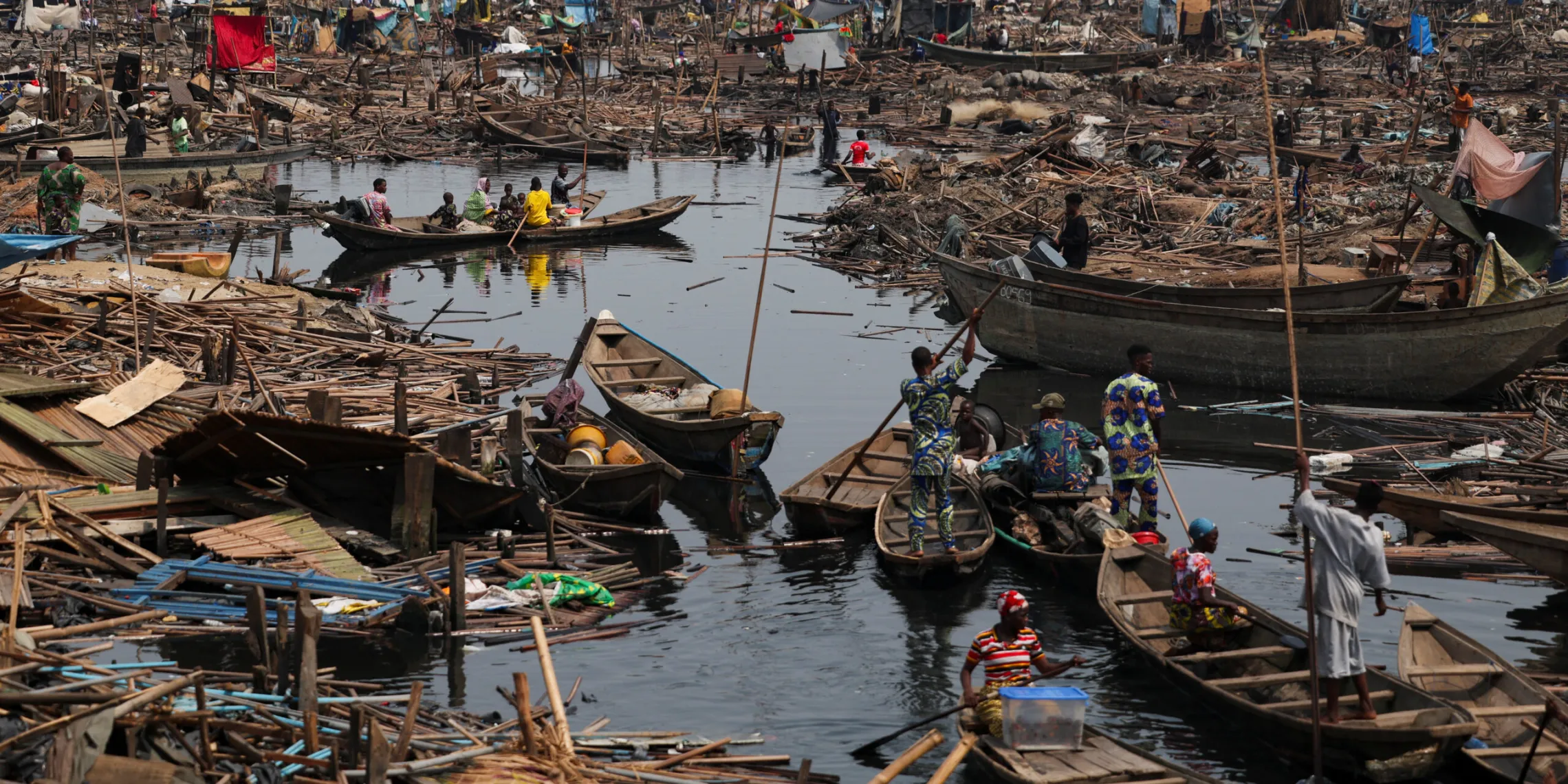
In Lagos, the demolition of informal settlements – often without adequate consultation, notice or resettlement – has turned the promise of ‘housing for all’ into a tale of loss, displacement and deepening urban poverty.
One of the United Nations (UN) Sustainable Development Goals is to upgrade slums and informal settlements by 2030.
The emphasis is on securing tenure, preventing forced evictions, improving access to water and sanitation, and ensuring dignified living conditions.
But ongoing state evictions of informal waterfront communities in Makoko, the world’s largest floating settlement, often called the ‘Venice of Nigeria’ – threaten lives and livelihoods, and exacerbate crime and humanitarian crises in Lagos.
From 1973 to 2024 there were 91 forced evictions in the city, directly affecting over two million residents. Large markets and commercial centres, schools and clinics were destroyed, compromising access to education and healthcare.
In July 1990, at least 300 000 people in the low-income community of Maroko in southeast Lagos were forcibly displaced.
About 30 neighbourhoods were affected, making this Nigeria’s biggest state-sponsored violent eviction. Similarly, in Oworonshoki in northeast Lagos, widespread demolitions started in 2023 and continued into 2025.
Demolitions in Makoko occurred from December 2025 to January 2026, with over 3000 homes reportedly destroyed and more than 10 000 people displaced.
The floating city is more than a century old and was home to nearly 300 000 people. Many thousands are now homeless, living on the water in canoes, sleeping on the streets and in temporary structures.
The state justified its evictions as an effort to improve residents’ living conditions and minimise exposure to flooding and other hazards. This reasoning is not peculiar to Lagos or Nigeria.
In 2024, Kenya’s government evicted people from high-risk riparian areas – some killed by bulldozers. Rights groups and residents argue that such justifications are often used to clear land for high-value development and gentrification rather than to reduce flood risks.
Amnesty International research on the demolition of the Otodo Gbame and Ilubirin waterfront communities on Lagos Lagoon in 2016 showed how state evictions worsened humanitarian crises and crime. Panicked residents ran for cover, with witnesses reporting that some drowned in the lagoon as they tried to escape gunfire.
Evictions are a destructive force that destroys social cohesion, increases poverty and homelessness, and drives up rates of theft, robbery and gun violence.
Some demolitions have been carried out by security forces backed by unidentified militia widely known as ‘area boys’ armed with machetes, guns and axes.
Many Makoko evictees were injured, and some families could not find their children. BONews reported that by 23 January 2026, at least 12 people, including two infants, had allegedly died from inhaling tear gas fumes during the demolitions.
These ruthless evictions are recent examples of a practice that has been occurring in Lagos for decades. For Makoko residents, many of whom rely on fishing to make a living, the waterfront represents home, jobs and survival. Forced evictions deprive them of everything: their livelihoods, aspirations, hope and possessions – and in some cases, their lives.
Studies show that for every 1 per cent increase in the eviction rate, there is a corresponding rise in violent incidents such as shootings.
Evictees, particularly women, girls and children, are susceptible to physical abuse when forced into precarious living situations. They either join Lagos’ millions of homeless or move to more disadvantaged and insecure informal settlements, creating a cycle of criminality.
Development that destroys lives and criminalises poverty is neither fair nor sustainable. There must be a better approach to developing Lagos without adding to the security crisis. All inhabitants have a right to the city, and the government must respect residents’ dignity irrespective of status. If land is needed to serve the public interest, residents must be consulted, compensated and resettled.
Violent evictions should be officially stopped until there are policies in place to ensure that removals comply with safety and security standards, and international human rights.
Lagos city planning must be more inclusive. The city cannot develop at the expense of poverty-stricken residents who are punished for decades of urban planning failures.
These inadequate approaches have segregated the city along income lines, giving elite neighbourhoods better infrastructure while leaving other areas underdeveloped.
The obligation of governments to refrain from, and protect against, forced evictions from homes and land arises from several international legal instruments.
These include the Universal Declaration of Human Rights, International Covenant on Economic, Social and Cultural Rights, International Covenant on Civil and Political Rights and Convention on the Rights of the Child, among others.
Urban spaces are needed where lower- and higher-income residents live together, rather than the detached spaces that dominate current city spatial development.
Mixed-income development is complex – but can have positive outcomes. It has successfully deconcentrated poverty and promoted neighbourhood revitalisation in both developed and developing countries.
The 233-unit mix of apartments commissioned in November 2025 at Abraham Adesanya Housing Estate in Lagos proves that this approach is feasible. But its success depends on deliberate, policy-driven, collaborative efforts between the state and private sector.
